Celebrating Doc Fred, Chewonki’s Beloved Master Naturalist
From our Fall 2025 Chronicle Alumni Magazine
For more than a century, natural history has been at the heart of Chewonki. From Clarence Allen’s earliest camp prospectus to today’s Nature Museum, learning through close observation of the natural world has been a defining thread of this place. For the last two decades, Fred Cichocki—known to generations simply as Doc Fred—has been one of its most faithful partners.
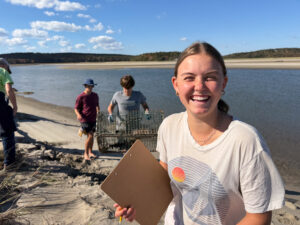
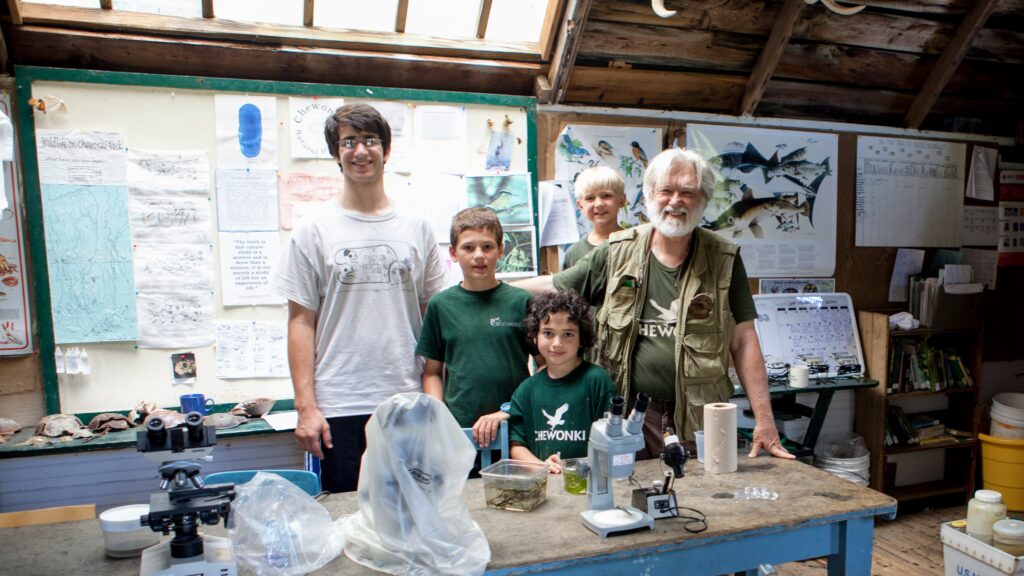
Walk across Chewonki Neck in summer, and you might catch sight of Fred with campers gathered around a jar on the table, puzzling over a “Natural History Mystery.” Sometimes a crab trap haul, sometimes a strange insect, always a question: What do you think this is? How might it live? These moments have become part of Chewonki’s living tradition—reminders that wonder begins with curiosity, and that curiosity, when guided well, can last a lifetime.
A Life Shaped by Curiosity
Fred’s fascination with the natural world began in childhood—watching ants on Detroit sidewalks, marveling at scorpions during a train stop in Arizona, and sneaking into the “restricted” section of his school library to devour geology books (“the librarian thought I was too young to understand!”). That early curiosity grew into a career that has spanned classrooms, museums, and fieldwork. In college and graduate school (where he studied ichthyology), he says that he was fortunate to have been mentored by perhaps, sadly, our last generation of classical naturalists—a lineage running back two centuries to Agassiz and Humboldt. Fred has shared his love of natural history with students from high school to college, co-founded the Maine Master Naturalist Program, and mentored young researchers exploring Maine’s biodiversity. He also remains active as adjunct curator of vertebrates at the Maine State Museum, where he helps curate collections that preserve Maine’s deep ecological story.
At Chewonki, Fred has spent more than two decades sharing his boundless curiosity with generations of students and campers. His message is both simple and profound: “We are part of Natural History,” he reminds them. “If we don’t see ourselves as part of this bigger story, we lose our sense of who we are.”
Beyond “Edu-tainment”
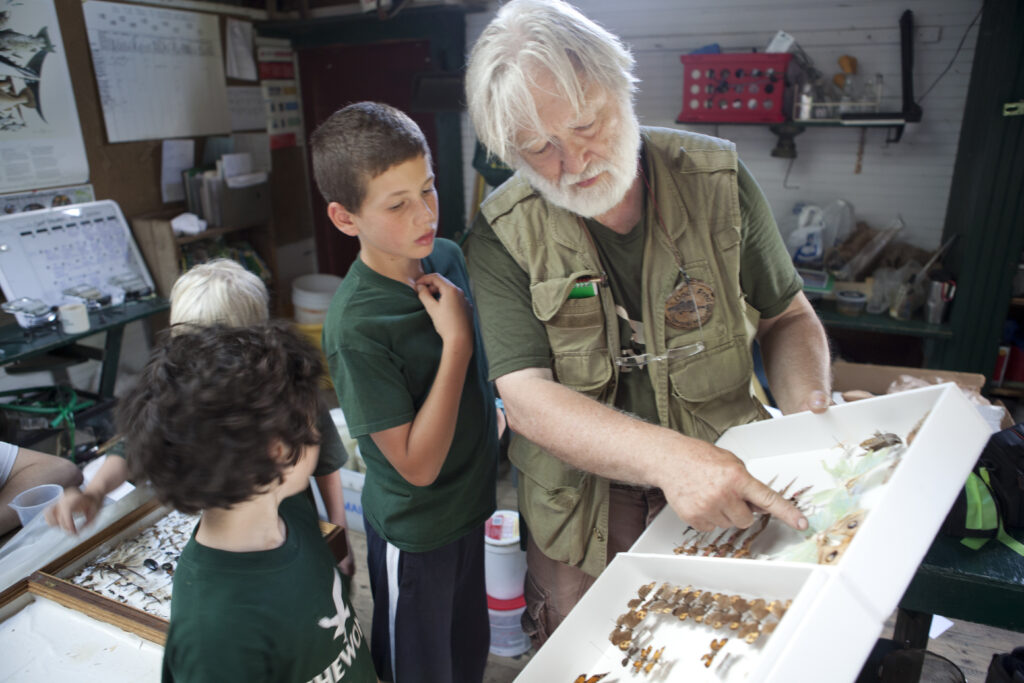
Fred is quick to point out that Natural History is not “edu-tainment”—his wry shorthand for teaching that stops at spectacle. For him, it’s never been about dazzling campers with curiosities (though there’s plenty of awe to go around). It’s about slowing down, cultivating patience, and helping students discover that the world is far more complex than names or labels. The real magic, he asserts, comes when a camper lingers long enough with a question to solve the mystery for themselves.
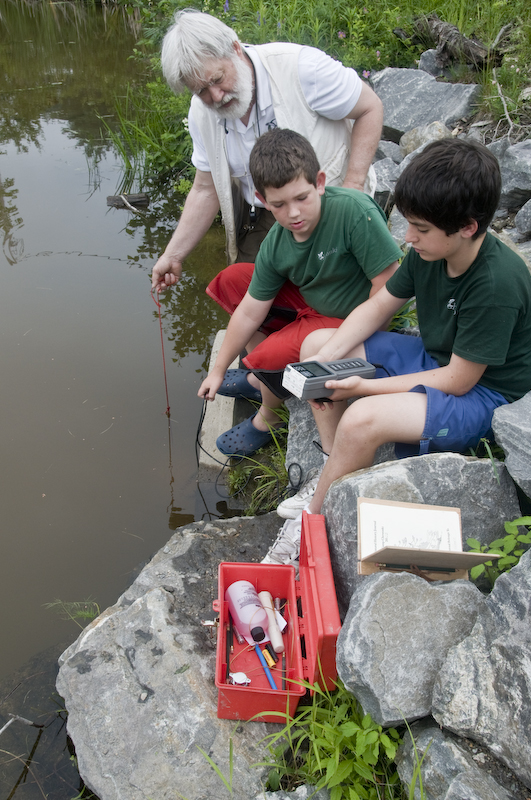
Over the years, his programs have included small mammal trapping, tide-pool excursions, geological adventures and even impromptu mussel feasts cooked with campers in the kitchen. Always, the goal has been the same: direct experience, attention to detail, and the joy of discovery.

A Legacy of Belonging
Fred often describes himself as a natural historian—a storyteller of nature. For him, names are only the beginning. “When you meet someone for the first time and learn their name, you don’t presume to know them. The same is true of a tree or a bird,” he says. “Knowing its name is just the beginning.”
Through this perspective, trees become characters in the unfolding history of a landscape. Fish and insects become reminders of resilience, adaptation, and beauty. His teaching has rippled far beyond Chewonki. Former students write to say his classes changed how they see the world—sometimes even how they live their lives. One business student, after four years of marketing classes, told Fred she was starting a natural fiber clothing line instead: “Now I see differently.”
What’s Next for Doc Fred?
Fred hasn’t made a final decision about retirement—whether another summer might draw him back—but he knows what’s calling: more days fishing, time with his wife Ginny, and his ongoing work at the Maine State Museum. Ginny, a former Chewonki staff member, is the reason Fred moved to Maine—so, in many ways, his life here has always been rooted in both Chewonki and the natural world they’ve shared together.
Whenever that day comes, Chewonki’s long tradition of natural history will endure. For nearly the past two decades, Fred has been its devoted partner, shaping how generations of campers and students experience the world. His imprint—the laughter over a crab boil, the thrill of an elusive pipefish slipping from a camper’s shoe, the hush of a group sauntering really slowly through the woods—will carry forward in the people he has taught, and in Chewonki’s enduring legacy of noticing, questioning, and wonder.